Back
Back
The question revenue teams should be asking is no longer “Should we use AI?” — it’s “Are we scaling it effectively?”
In a recent webinar, I spoke with SBI’s Ray Makela, and we kept coming back to one central theme:
The organizations outperforming their targets have moved beyond just experimenting with AI and are successfully operationalizing it for their teams and processes.
And nowhere is that shift more important than in the role of the sales manager.
Watch our full conversation on-demand here.
The AI Maturity Curve
In the webinar, Ray outlined a simple but powerful AI maturity model that companies can use to measure their adoption level:
Level 0 – AI Aware: Companies that know they could and should be leveraging AI, but don’t use it (or don’t trust it).
Level 1 – AI Learning: A company has individuals that are experimenting with AI in their day-to-day work, but have no systemized approach to AI adoption.
Level 2 – AI Active: Teams within a company are relying on AI consistently in daily workflows.
Level 3 – AI Fluent: Companies with org-wide initiatives for driving innovation, mentoring others in AI usage, and scaling use cases.
Most organizations are stuck somewhere between Levels 1 and 2. More than a few people within the company are using AI to save time and streamline certain workflows, but there’s no playbook
The ones pulling ahead are those that have strategically put systems in place that move teams toward Level 3.
AI Adoption Is Now Correlated With Performance
SBI’s research across 600+ B2B transactions found a strong correlation between scaled AI adoption and revenue overperformance.
This refers to companies that are actively integrating AI into their workflows and sales processes, codifying best practices, and consistently sharing effective prompts and use cases internally.
The research shows that the companies that have these practices in place are outperforming those that don’t. That’s the difference between AI awareness (Level 1) and AI fluency (Level 3).
The Frontline Manager Is the Leverage Point
Frontline managers are some of the busiest people in the revenue organization.
SBI’s time study shows nearly half their time is spent on reporting, admin work, pipeline hygiene maintenance, and internal coordination.
All of these relatively behind-the-scenes tasks eats up time that could be spent on strategic work like coaching, performance management, deal acceleration, and talent development.
And yet, research consistently shows the top reason employees leave companies is related to their frontline manager. This reveals a direct correlation between coaching quality and retention.
From Coaching Chaos to Coaching Operating Rhythm
Best-in-class revenue teams don’t leave coaching to chance; they operationalize it by defining:
- Weekly 1:1 cadence
- Team meetings
- Ride-alongs
- Monthly performance deep dives
- Annual development reviews
This is a coaching operating rhythm, and it’s the key to consistent, scalable coaching.
The final puzzle piece in truly operationalizing coaching is proving that coaching is happening, effective, and time-efficient.
This is where AI can be a huge unlock for revenue teams.
AI as the Coaching Accelerator
AI is giving frontline managers a head start, not replacing them.
Instead of spending 30 minutes prepping for a 1:1, it takes just seconds for a context-aware AI assistant to:
- Aggregate performance trends
- Surface pipeline changes
- Highlight skill gaps from call data
- Identify deal risks
The manager still leads the conversation, provides context, and has trust-building conversations, but now they come into the conversation more informed with less prep time.
And when coaching is both personalized and programmatic, performance scales.
The Shift That Matters Most
The conversation around AI in sales often centers on prospecting and messaging, but in truth the bigger opportunity is internal.
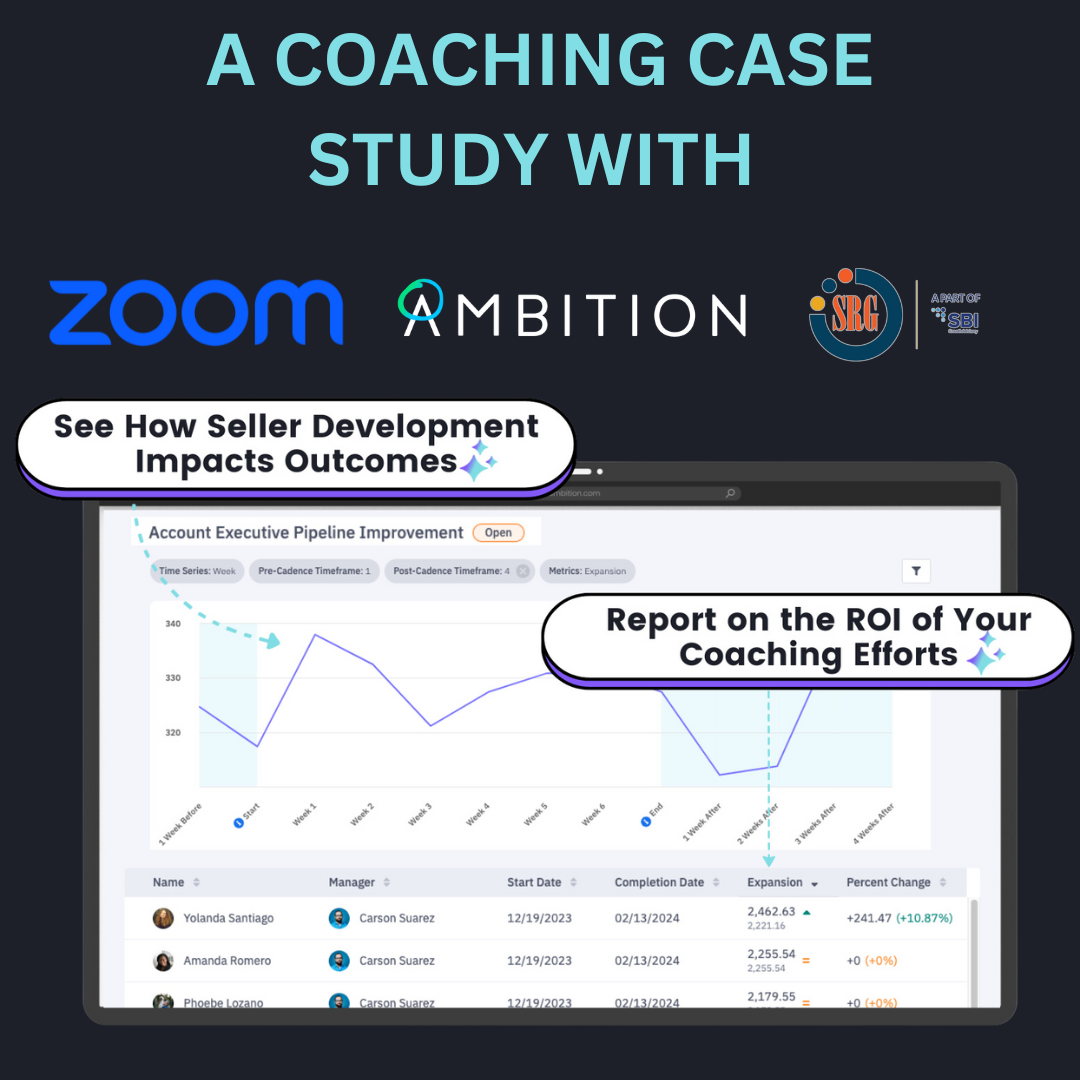
AI gives revenue leaders the ability to codify the playbook, consistently reinforce methodology, track coaching execution, and tie coaching efforts directly to pipeline movement.
The companies that win the next five years won’t just adopt AI, they’ll embed it into the operating rhythm of their frontline managers.
For more, you can access the full webinar on-demand here.
To see how AI can transform your seller activation and manager workflows, get a demo of Ambition.