.svg)
.svg)
.svg)
How to Run an Engaging Coaching 1:1 (That Actually Delivers Outcomes)

Most "coaching" 1:1s are pipeline inspections with better branding. The seller recaps deals, the manager nods along, and everyone leaves with a vague sense that things should improve. Nothing changes by the next session.
Here's a five-step format that fixes it, built on Mike Kunkle's ROAM framework (Results vs. Objectives, Activities & Methods) and runnable in 30 minutes.
Step 1: Put it on the calendar and don’t cancel last second
A coaching session both sides know is coming is a session both sides prepare for. Recurring invite, consistent cadence, protected time. Don't let it get bumped for a "quick deal review."
If it's negotiable, it's optional. If it's optional, it's dead.
Step 2: Prepare. Never open with "So, what should we talk about?"
That question feels collaborative. It isn't. It flips the work back onto the seller and tells them you didn't look at anything before walking in.
The prep doesn't have to be manual. In Ambition, managers use an AI Skill - either from a ready-made template or one they've configured - to analyze performance trends, goal progress, and pipeline changes ahead of the session. It returns a brief summary and a set of recommended topics, so you walk in with a point of view instead of a blank page.
However you do it: arrive with the pre-read done.
Step 3: Run a consistent structure (such as opening with Results vs. Objectives)
Ok maybe you have a few brief ice-breaker / catch up moments… THEN:
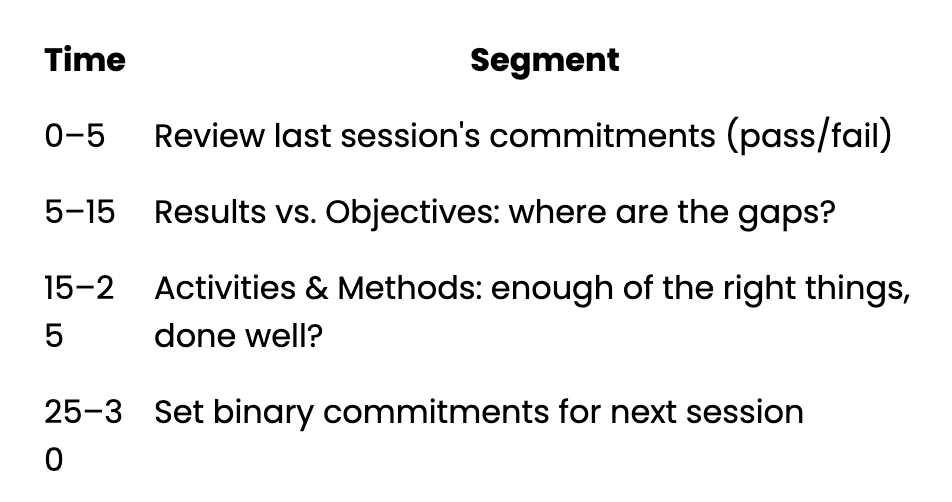
Consistency is what turns a recurring meeting into a path to action. ROAM gives you that structure, and it starts with one comparison: actual results vs. stated objectives — across activity, pipeline, revenue, and development goals.
That comparison surfaces authentic areas to improve. Not the manager's hunch, not last week's anecdote — the gap between what was targeted and what happened. As the manager, you should already have a hypothesis or two about why the gap exists.
One prerequisite: if you don't have clear objectives to compare results against, stop. That's a separate problem, and it's the one to solve first.
Step 4: Diagnose with Activities & Methods
You've found the gap. Now run it through two questions, in order:
Activities — are we doing enough of the right things? Pick a small number of activities (or metrics) to focus on for the next period. Volume and mix, not everything at once.
Methods — are we doing those things well? Effort without effectiveness just produces more misses. Is there a defined process behind the activity? Are we actually running our qualification framework (BANT, MEDDPICC, whatever your team has committed to) or just going through motions?
Activities tell you what to do more of. Methods tell you how to do it better. Most coaching conversations skip straight to one or the other; the diagnosis is in checking both.
Step 5: Leave with binary action items
End every session with a short list of commitments that can be measured pass/fail by the next session. "Work on discovery" is not an action item. "Run the new discovery framework on 5 first calls and bring the recordings" is.
Binary commitments do two things: they make the next session's opening automatic (did we do them or not?), and they compound. Each session picks up exactly where the last one left off — which is what makes it coaching instead of a recurring status update.
The 30-minute version:
ROAM is Mike Kunkle's framework. It is worth reading his work on sales management systems at mikekunkle.com !
See the system in action
Insights for high-achieving sales teams
.png)

.png)

Stop chasing targets, start predicting revenue
Transform your revenue org into a high-performing growth engine with structured insights, top-down visibility, and built-in consistency.
%20(1).png)
.svg)
.svg)