


AI Is Not Free Magic: What Has (and Hasn’t) Changed in Sales Since Predictable Revenue

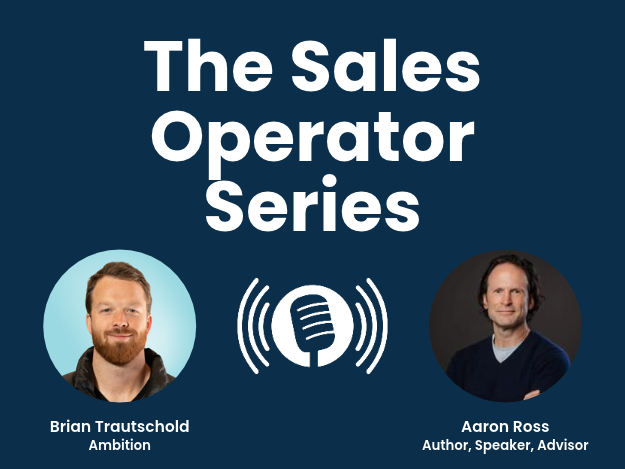
A conversation with Aaron Ross on why AI is a temporary edge, why doing more isn’t the same as doing better, and why pods and “narrow to win” may matter more than another tool.
When we started Ambition in 2014, Predictable Revenue was the operating system for building a sales organization. I remember reading the PDF version. So I was excited to sit down with its author, Aaron Ross, co-author of From Impossible to Inevitable, on the Sales Operator Series and ask what’s changed since.
His answer was “almost everything is generally the same.” That makes for a useful reality check when everyone is talking about how AI is changing sales. (We also covered his life as a father of 10 who moved his family from California to Edinburgh, which is worth a listen on its own.)
Here’s a recap of our conversation. You can watch the full episode below.
Key takeaways for sales leaders
- Sales and marketing are still psychological exercises between two people building trust. Technology doesn’t change that.
- AI is a superpower only until everyone uses it. Eventually “AI process” will just be “process.”
- AI isn’t free magic. It creates an illusion of simplicity and often produces more work, not less.
- Aaron’s remedy is “narrow to win”: narrow your markets, channels and campaigns so you can do fewer things well.
- Trust moves in layers. Aaron’s “arc of attention” and “layers of the onion” explain how to earn more of a prospect’s time.
- AI is especially useful for managers (data analysis, comp plan design) and for researching a prospect’s business, but curiosity is still a human job.
- Tools have to fit into the workflows your team already uses. You won’t get sellers, managers or leaders to adopt a new thing.
What has changed in sales since Predictable Revenue, and what hasn’t?
Aaron circulated early drafts of Predictable Revenue around 2010 and self-published it in 2011. It became the way a generation of Silicon Valley-rooted SaaS companies designed their headcount, roles and processes. That influence can't be overstated.
When I asked what’s different in 2026, he went straight to the fundamentals. He sees sales and marketing as psychological exercises between two people who don’t know each other yet, with little or no trust. He’s seen pre-internet, the internet, mobile, and now AI, and says lots has changed but lots hasn’t (and won’t). In fact, he thinks some of the problems Predictable Revenue helps to solve will get worse with AI, because the instinct is to throw more technology at problems caused by technology.
Is AI a lasting advantage in sales?
Aaron describes this as a transitional time. Many people are using AI to speed things up and be more efficient, and he doesn’t think that will make much difference to a business. Getting invoices paid faster or posting content faster doesn’t change the business. If you’re using AI and others aren’t, you have a superpower. If everyone is using it, no one has one.
He compared it to jumping onto Instagram or YouTube early: you had a big advantage, until everyone arrived and it got hard again. In a year or five, he expects we’ll stop talking about “AI process” and “AI apps” the same way we don’t talk about “internet process.” It will just be in the wiring.
That’s also why AI rarely comes up when he’s planning a book or keynote. He’s thinking about what will be relevant in 5 to 10 years, and it isn’t prompt engineering or even the word “agent.” It’s how technology affects the job, the business and the people. He personally loves AI and uses Claude and ChatGPT, though not much for automation.
Why does AI often create more work, not less?
The line from Aaron I keep repeating is that AI is “not free magic.” He doesn’t just mean the cost. People think they’ll “AI that thing,” whether it’s a report, a presentation or a tool, and then realize how hard it still is to get it to a high-quality, working result.
His explanation is that AI creates an illusion of simplicity. Because you can do more, and because everyone else seems to be doing more, there’s no natural limiter. Our eyes are bigger than our stomachs, and it’s easy to start things. He compared it to the Sorcerer’s Apprentice scene in Fantasia: you solve one task and get two more back.
He also pointed out that most salespeople still struggle with AI because most people aren’t made for chatbot interfaces. Once it’s baked into the apps they already use, he expects that to improve. And while some people can work less with AI, he says you have to design for that on purpose. Otherwise the hamster wheel in your head just spins faster.
What does “narrow to win” mean?
I asked what a leader of hundreds of sellers should do when conversion rates are falling. Aaron said to start by realizing that just because you can do more doesn’t mean you should. His answer is “narrow to win,” which can apply to:
- The product roadmap
- Which markets you go after, as a company, team or person
- How many campaigns you run and what types
- How many channels you use
Just because you can run 10 channels doesn’t mean you should, because it’s still multitasking. Maybe you can do two really well, but not three. He called narrowing the first step.
How do you build trust with prospects who don’t know you?
Aaron offered two models.
The arc of attention comes from From Impossible to Inevitable. The people closest to you will give you a lot of attention, and each degree further away gives you only a sliver. So you start with relationships and referrals. But you exhaust your networks at some point. He said $5 to $10 million has been a common plateau, at least in the past. Beyond that, you’re reaching new markets where people don’t know you, and going from zero trust to a little trust is a big step.
The layers of the onion comes from Predictable Revenue. You earn attention step by step. If someone will look at your email, maybe they’ll text you. If they’ll do that, maybe they’ll watch a two-minute video or take a 10-minute demo. If they’ll do that, maybe they’ll do an hour-long discovery call. Marketing can run the opposite way: an ad, a landing page, a chatbot, a person, a demo, a free trial.
He also noted that the battle for attention is getting harder. People get more messages on more channels, plus the emotional weight of seeing everyone else “crushing it.” Each of those drains what he calls a mental battery, leaving less energy for the bigger decisions.
Where does AI help sales managers most?
I brought up that the sales managers we work with are often former top sellers who now manage six people. They’re not data analysts, and they’re staring at more dashboards than ever. Analyzing data trends is an obvious place for AI, and Aaron added comp plan design.
On the seller side, I said I see people being lazy about understanding a prospect’s business, and an AI summary could help. Aaron offered a twist: they’re probably not lazy. They’re in sales for the selling and aren’t interested in the prospect’s business. He’s always been interested in businesses. I agreed that curiosity is a skill we’ve lost. It’s hard to present value and build trust when you’re only interested in pushing your thing, and I blame our industry for training people to go through the motions.
Could pods and mini franchise teams be the future of sales?
Aaron said that if you’ve read Predictable Revenue, you might remember a couple of pages on pods and “mini franchise teams.” He plans to bring the idea back, because for companies in fast-changing situations he thinks it may be the best way to organize people. He was careful to say it’s not for everybody.
I told him we’re running pods right now, in our strategic accounts: a relationship owner, people underneath who work like CSMs delivering value, and a direct link to people in product and engineering, so account feedback flows into product delivery. Aaron said he pitched a version of this at Salesforce, but it wasn’t the right time. He also said that the bigger breakthrough won’t come from automation, but from reorganizing people in new ways. We agreed to dig into this in a future conversation.
How do you filter out the noise and play your own game?
Part of our conversation touched on “compare and despair,” especially on LinkedIn. Aaron said it’s easy to feel like you’re failing when everyone seems to go from zero to $100 million in six months. I said it creates bad decision-making because you’re optimizing for a dopamine spike.
His practical filter for leaders: there’s too much good advice out there, and you can drive yourself crazy. Instead of acting on what people are doing on LinkedIn, ask whether you’re actually doing it, whether it worked for you and whether it’s relevant to your situation. When something works, you set the example for your team.
Why do tools need to fit into existing workflows?
Aaron mentioned a CRO of a big company who has 20 different apps and can’t get a single pane of glass. He doesn’t think that’s going away.
My belief is that AI will let the work happen where it already happens, whether in a Zoom call, Slack, Salesforce or a meeting with four people, instead of making people go to another web app. Aaron agreed, noting that on a board he sits on, the company is struggling with adoption because it’s asking salespeople to follow a different process outside their normal tools. Bringing the improvement to where people already work is like pushing a boulder downhill instead of uphill.
After about twelve years in this business, I’ve learned you’re not going to make salespeople do a new thing, and you’re probably not going to make managers or revenue leaders do one either. It has to be in the flow of how they want to work.
What I’m taking away
The takeaway for me is to be skeptical of anything that promises to make us do more. The fundamentals Aaron points to (trust, attention, curiosity, focus) haven’t moved, and AI’s most valuable role is probably in the places where people are weakest, like analysis, and in the flow of work they already do.
To hear the whole conversation, including Aaron’s life with 10 kids and the move to Edinburgh, watch the full episode on the Sales Operator Series. You can find Aaron on LinkedIn.
See the system in action
Insights for high-achieving sales teams



Stop chasing targets, start predicting revenue
Transform your revenue org into a high-performing growth engine with structured insights, top-down visibility, and built-in consistency.


