


Your sales methodology needs a place in everyday coaching


How Ambition’s Performance Graph connects people, performance, and procedures to help managers put your sales approach into practice.
There’s a lot that goes into choosing a sales methodology. Leaders evaluate the approach, invest in training, and ask their teams to change how they sell. They’re making a bet on the skills and behaviors that will help their people succeed.
Then comes the harder part: making that approach part of everyday work.
The frontline manager plays a big role here. They’re the person helping a rep apply what they learned to a real conversation, a difficult deal, or a skill they’re still developing. They’re also preparing for that conversation with information scattered across dashboards, CRM records, call recordings, and notes from the last 1:1.
Somewhere in all of that, they need to bring the methodology back into the conversation.
It’s easy to see how consistency breaks down. A manager may believe in the approach and still struggle to reinforce it week after week. A rep may understand the training and need help applying it. A CRO may have made a meaningful investment and still have limited visibility into how it shows up in coaching.
I think we too often treat this as a people problem when the process deserves a closer look. Good intentions need a structure that makes follow-through possible.
Give your methodology a role in the work
Ambition’s Performance Graph connects people, performance, and procedures. Together, they help give coaching context: who needs support, what’s happening in their performance, and how your organization expects them to work. Here’s how that looks in practice:
- People: Who is responsible, how teams are organized, and what each person has permission to see.
- Performance: The metrics, KPIs, goals, and pipeline context that help explain what needs attention.
- Procedures: How work gets done, including the methodology, plays, workflows, and operating rhythms that guide your team.
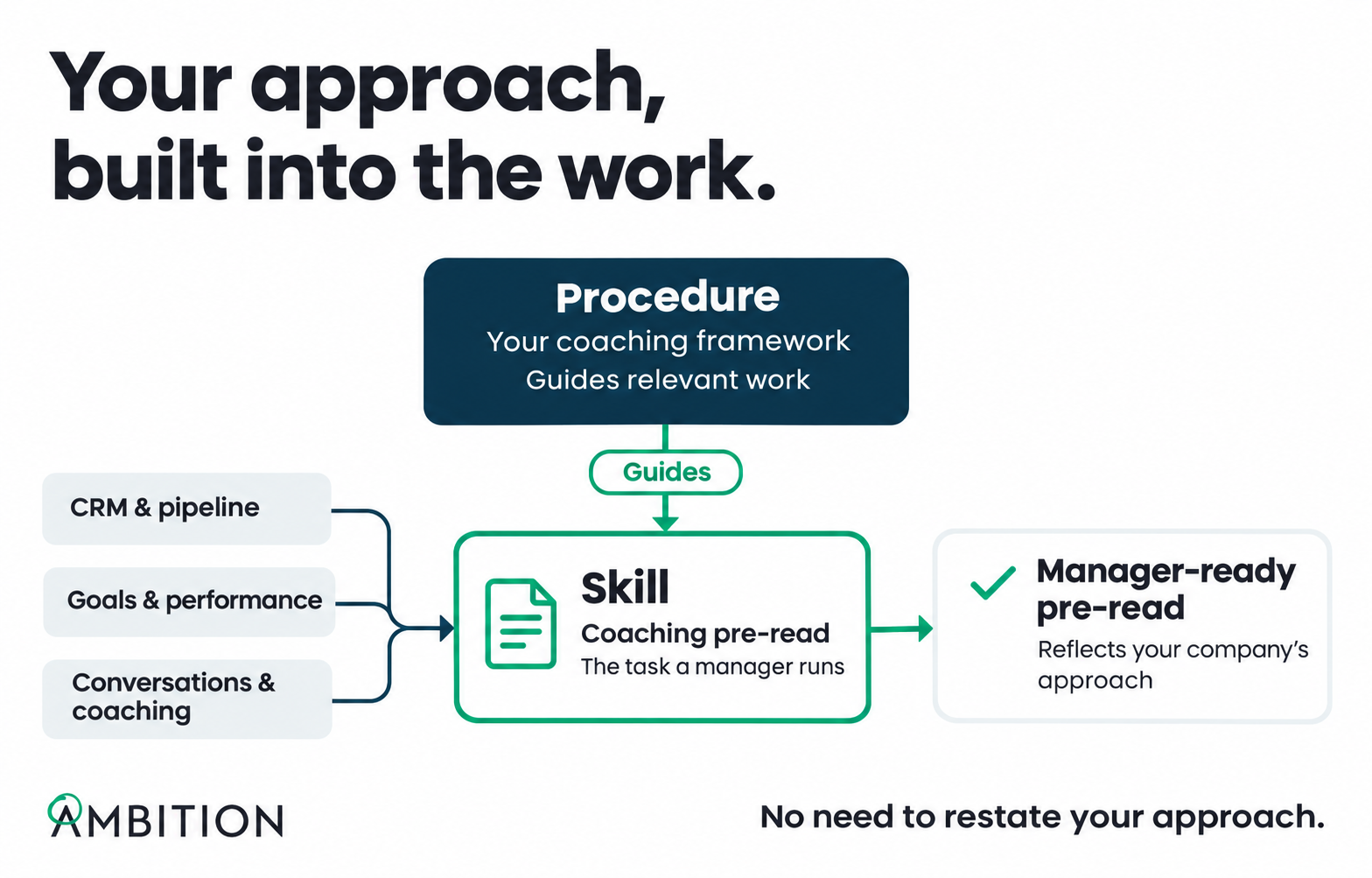
Procedures are especially interesting to me because they give your organization’s approach a role in the guidance managers receive. They ensure AI output applies your standards to the situation a manager is working through.
A sales methodology describes how you want your team to sell. A qualification framework helps define what they need to understand about an opportunity. A coaching framework helps managers develop those capabilities. Each can inform the guidance your organization sets up in Ambition.
A Procedure defines when guidance applies, what the agent should do, and which audience it serves. When a request matches that situation, the agent loads the relevant instructions. A manager inspecting an opportunity can get analysis grounded in the organization’s qualification standards. A simple request for a deal’s value doesn’t need the same guidance.
Bring the methodology into a real coaching moment
Whether your team follows an established sales methodology or an approach you’ve developed internally, Procedures help bring those standards into the agent’s guidance. A manager can ask the agent to review opportunities against that approach and suggest coaching points grounded in how your organization sells.
That’s a practical starting point: bring the approach your team has learned into the preparation for a real manager–rep conversation.
Imagine a rep whose opportunities keep stalling after discovery. The manager needs to understand what the rep is learning about the buyer’s problem and where they need support. With the relevant methodology guidance and available opportunity evidence, the agent can help focus that preparation.
The manager might then ask: “What did we learn about the impact of this problem? What are we still assuming? How could you explore that with the buyer?”
Those are illustrative questions, but they show how the pieces connect. Performance provides the signal. Procedures provide the standards. The manager brings judgment and knowledge of the rep to the conversation.
The evidence still matters. A CRM field being filled in doesn’t necessarily mean a rep has confirmed something with the buyer. If the source information is missing, the agent should identify that gap. The manager can then explore it with the rep and decide what to do next.
That gives coaching a more specific focus and gives the rep something concrete to practice.
Consistency matters to the person being coached
We often talk about consistency from a leadership perspective: managers following a cadence, teams using the same framework, an investment being reinforced.
There’s a human side to it, too.
Think about what coaching feels like when expectations change from week to week. One conversation focuses on activity. The next is entirely about a deal. A development goal comes up once and then disappears. The rep is left trying to understand what matters and how to improve.
Shared expectations can make that experience more predictable. The rep understands the skills they’re working on, why those skills matter, and what their manager will help them practice. Follow-up gives the next conversation continuity.
To me, that’s part of building trust. Coaching is personal. People need to feel that their manager understands their situation and will follow through on the development they’ve discussed.
A consistent structure leaves room for that relationship. Managers can adapt their questions and support to the individual while working from common standards. Those standards also give feedback a more concrete basis in observable behaviors, with room for the rep to add context and challenge an interpretation.
Adoption deserves as much attention as the framework itself
Our State of Sales Coaching in 2026 report points to the importance of consistent execution. Among organizations reporting consistent adoption of a coaching framework, 37% reported higher quota attainment compared to where the framework adoption varied by manager, and even higher where there was no framework.
These findings are correlational, and the research examines coaching frameworks specifically. They reinforce a practical question for leaders: once you’ve established an approach, what helps managers use it consistently?
That’s the opportunity for the Performance Graph. Connecting people, performance, and procedures helps bring your standards into the context managers use to prepare and coach.
For the CRO, it creates a practical way to carry the investment in a methodology into management workflows. For the manager, it provides guidance grounded in how the organization wants to sell. For the rep, it supports development around clear expectations and relevant skills.
Your methodology needs a place in the moments when people are learning, making decisions, and getting support. Everyday coaching is one of those places. The Performance Graph helps connect the strategy you’ve chosen to the work your managers and reps do together.
Bring your sales methodology to an Ambition demo and explore how it can guide the work your managers do every day.
See the system in action
Insights for high-achieving sales teams


Stop chasing targets, start predicting revenue
Transform your revenue org into a high-performing growth engine with structured insights, top-down visibility, and built-in consistency.


