.svg)
.svg)
.svg)
Revenue Intelligence Has a Context Problem. We Built the Performance Graph.

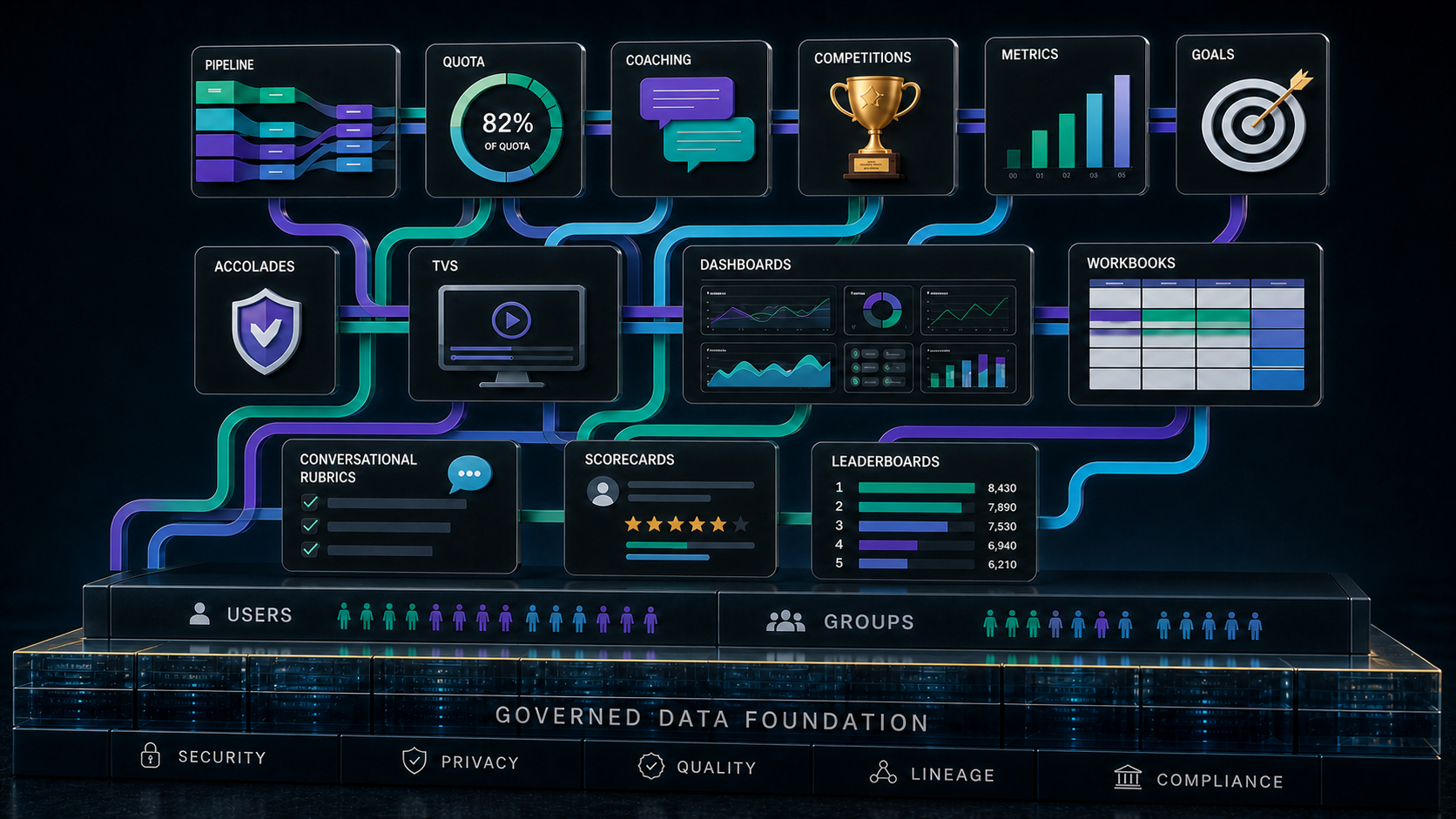
AI is exposing a structural weakness in revenue software: the systems that record the business do not understand how the business performs.
A revenue leader should be able to ask which opportunities materially changed this week, which changes put the quarter at risk, whether the reps behind those deals are showing the same gaps in their calls and activity, where the sales methodology is breaking down, and what the organization should do next. The data exists. The answer usually does not.
These are not database questions. They depend on people, managerial hierarchy, time, ownership, business definitions, history, privacy, and the actions the organization has already taken. No single source understands how those pieces explain performance.
Connecting an AI model to every source does not create that understanding. It asks the model to reconstruct the business at query time, when context is most limited and mistakes are hardest to govern.
Ambition's Performance Graph is our answer. It is the AI-native analytical foundation behind the next generation of Ambition: an employee-centered model that connects pipeline, quota, activity, conversation, and operational data; turns raw events into business meaning; preserves how that meaning changes over time; and enforces access before an answer is calculated. It brings CRM, sales engagement, conversational intelligence, and HRIS data together with the goals, scorecards, coaching sessions, and commitments created inside Ambition. The result captures what happened, what the organization expected, and how its people responded.
The design principle is simple: prepare the context before the model needs it.
For Ambition, that means resolving four things before AI answers: who the data belongs to, what it means, how it changed, and what the person asking is allowed to see. When a model has to infer those details at prompt time, the result can sound convincing and still be wrong.
With that context already in place, a revenue leader can ask:
Show me every meaningful pipeline change across my organization since last Monday. Explain which changes put the quarter at risk, identify the behaviors connected to those deals, and prepare the evidence each leader needs for the next pipeline review and coaching conversation.
This is not a prebuilt report disguised as a prompt. It is a path through a governed model of the sales organization. Ambition can reconstruct the earlier pipeline, explain the movement, connect it to performance and coaching, and turn the answer into a live dashboard, leadership brief, or coaching plan. The analysis does not end in a chat window. It becomes part of how the organization operates.
Context Is the New Revenue Infrastructure
Revenue stacks were assembled system by system. CRMs organized accounts and opportunities. Engagement tools captured activity. Conversation platforms recorded calls. HR systems maintained people and reporting lines. Warehouses centralized the resulting data. Each contains a useful part of the truth. Revenue performance lives between them.
Before AI, that fragmentation cost analyst time and leadership attention. In an AI system, it becomes an accuracy and governance problem: the model must recover employee ownership, business definitions, history, fiscal time, and permissions from disconnected sources. More tokens cannot supply meaning the sources never encoded.
The Performance Graph makes those facts explicit before inference. It is the missing operating layer above storage and integrations.
Consider the pipeline question above. By Monday morning, a CRO can see which regions changed the quarter, a revenue operations leader can inspect the opportunities behind the movement, an enablement leader can see where the sales methodology is breaking down, and a frontline manager can enter the next coaching conversation with the right evidence. Each person works from the same analysis, filtered to the organization and data they are allowed to see.
One Question, All the Way to Action
In the sequence below, a revenue leader asks for the Monday operating brief. Ambition explains the quarter-level movement, traces it to the exact opportunities and owners, and prepares the coaching conversations that should happen next.
One question produces the quarter-level explanation, the deals behind it, and the coaching priorities for the week.
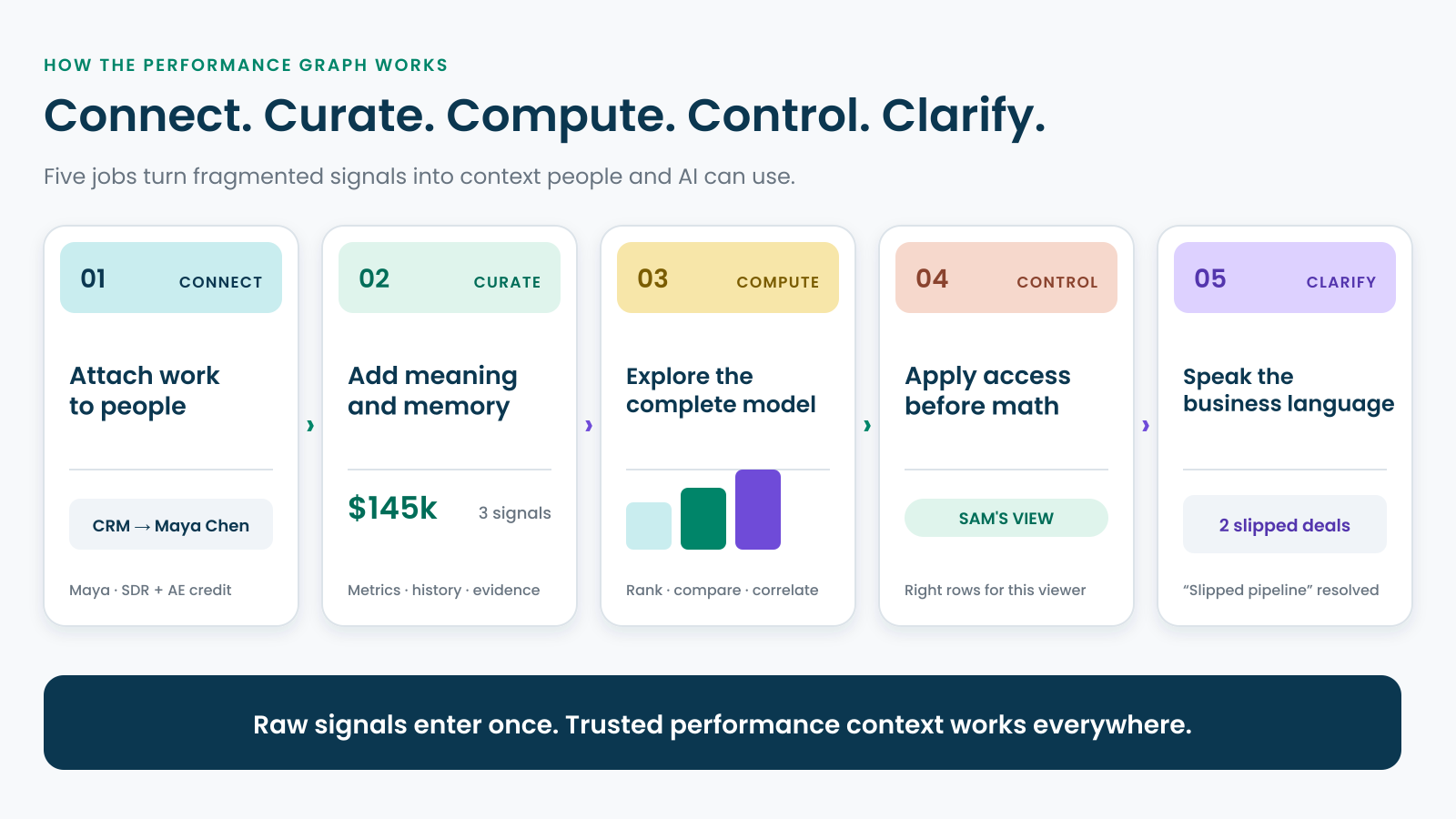
How the Performance Graph Works: Connect, Curate, Compute, Control, Clarify
The Performance Graph connects work to people, curates raw data into business signals, computes across the resulting model at interactive speed, controls what each viewer can see, and clarifies the language of the business for AI.
Connect the Work to People
Most revenue systems center accounts and opportunities. Performance is managed through people.
Ambition connects employees, managers, roles, territories, groups, employment history, and time off with records from CRM, sales engagement, conversational intelligence, custom integrations, and our APIs. A record can credit an SDR, account executive, and customer success manager differently while retaining the shared deal underneath it. Those relationships keep their history, so Ambition knows who managed an employee during a period, which team owned the rollup, and where that employee's workday began. “My organization” resolves to a known population and credit model.
Curate Before the Question
Connected data is not prepared data. Three forms of curation matter for revenue AI.
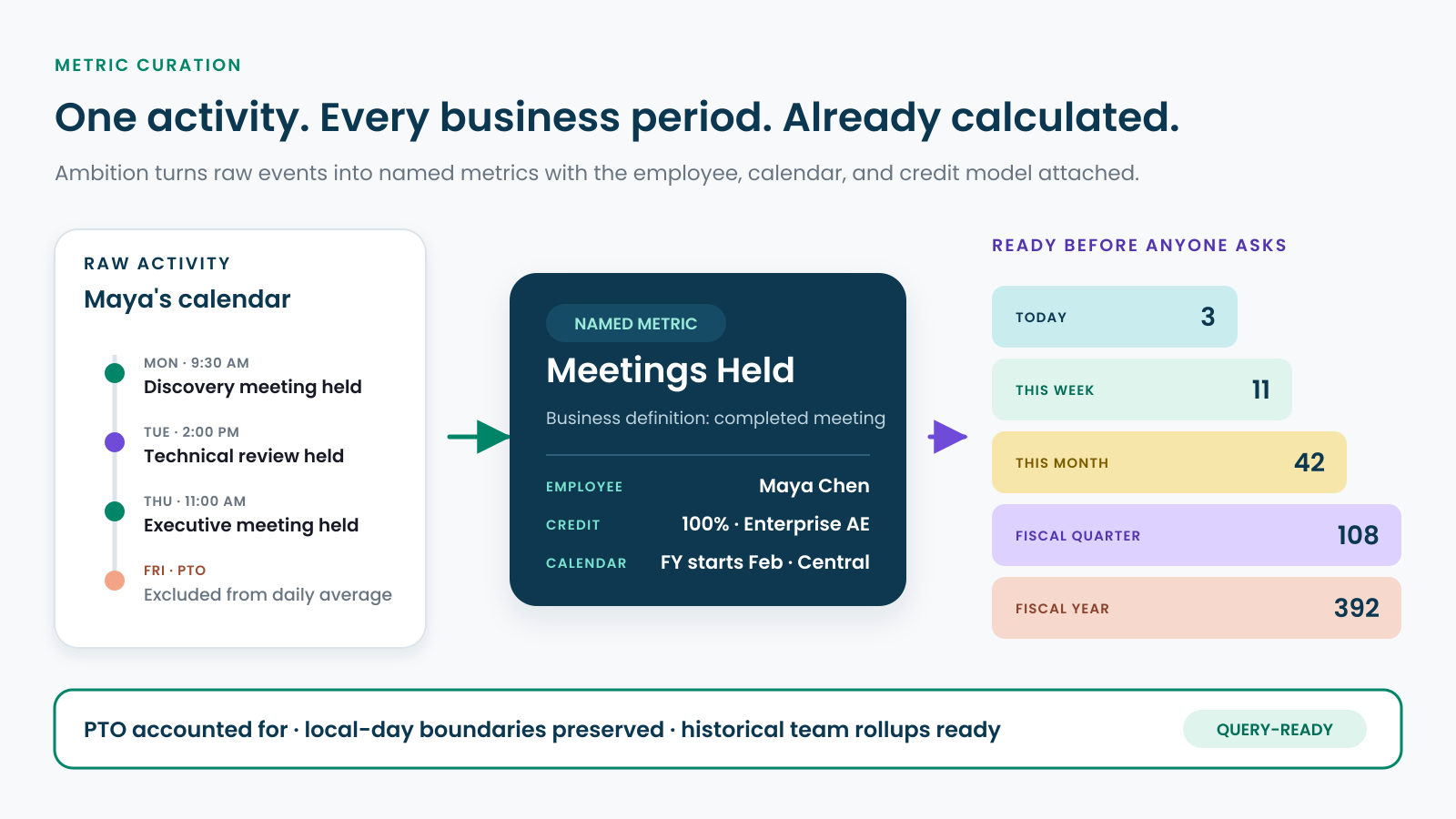
Business metrics. Raw activity becomes a named measure such as Pipeline Created, Meetings Held, or Revenue. Ambition continuously calculates those metrics across employees, teams, reporting periods, and fiscal calendars. Working days, time zones, historical group membership, time off, and credit rules are already reflected. The Agent receives a business definition, not an anonymous number.
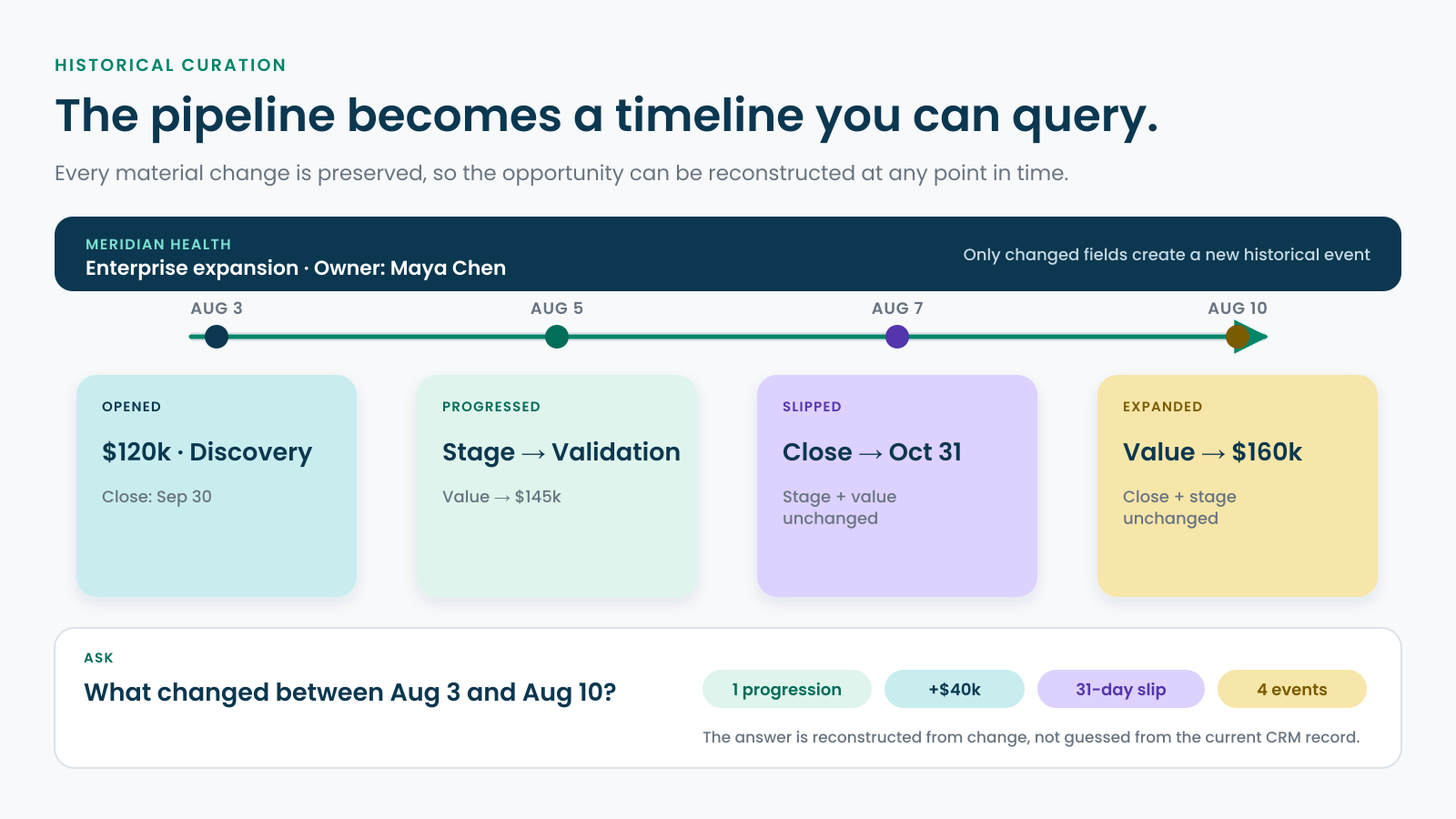
Meaningful history. Ambition preserves material record changes without storing another full copy when nothing happened. That turns pipeline from a snapshot into a timeline. Any two dates can be compared to find stage progression, regression, value changes, forecast changes, and opportunities moving into or out of a period.
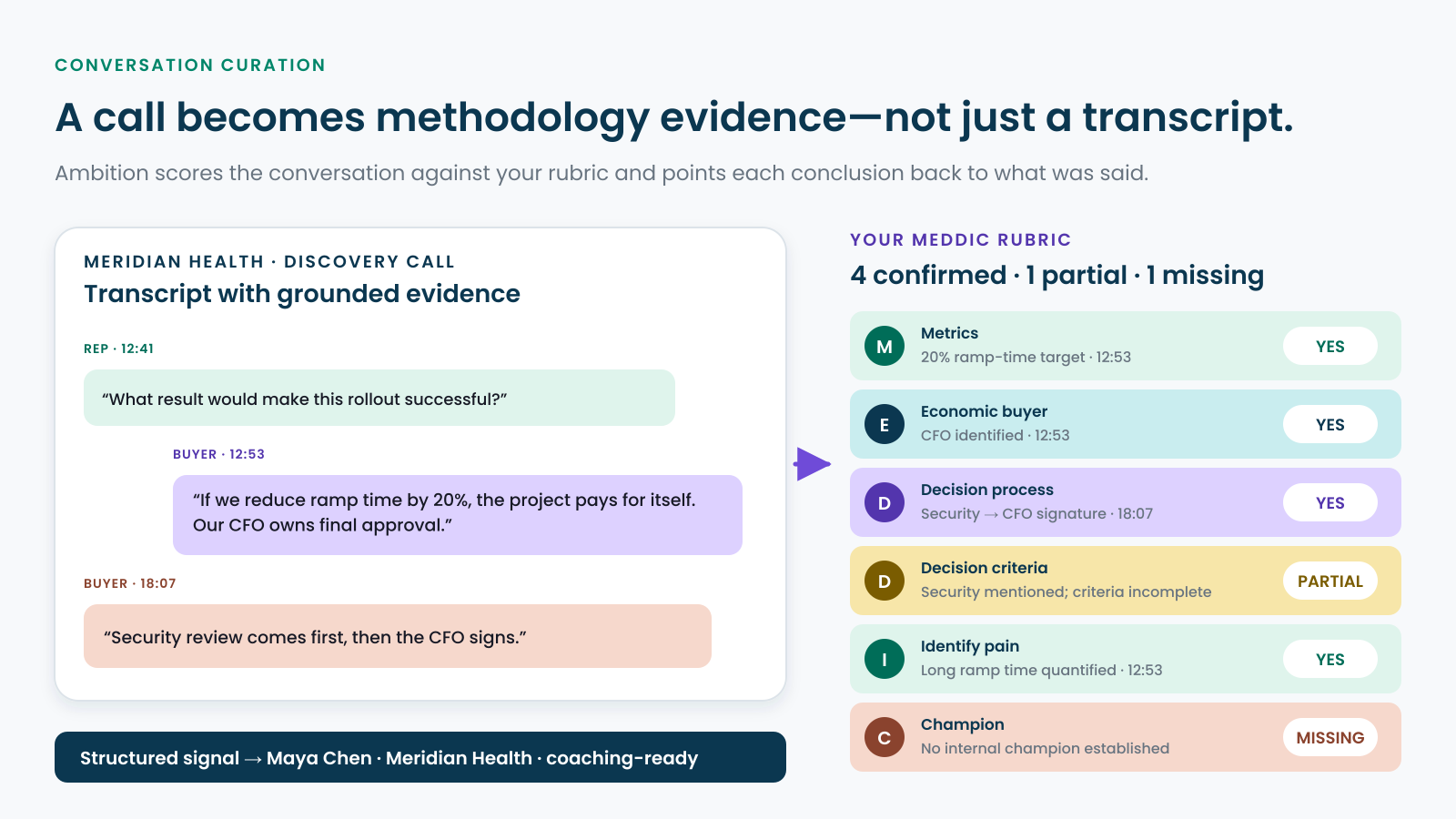
Grounded evidence. Calls and other unstructured material can be evaluated against the organization's methodology, scoring rubrics, and pipeline hygiene standards. The result becomes structured evidence connected to the employee and opportunity, with each conclusion pointing back to its source. Revenue and enablement leaders can compare methodology adherence across teams while retaining the evidence behind every conclusion.
Curation continues inside Ambition. Goals and scorecards define expectations. Coaching sessions capture judgment and commitments. Achievements, competitions, and alerts record how the organization reinforces performance.
A CRM may know that an opportunity changed stage. The Performance Graph can also know that the rep discussed the deal in coaching, committed to a next step, and is measured against the related behavior. That is the difference between observing the business and helping manage it.
Compute at Interactive Speed
Prepared context loses value if every follow-up becomes an offline analytics project. We rebuilt Ambition's analytical foundation on ClickHouse so large histories, aggregations, rankings, and statistical analysis can behave like ordinary product interactions.
ClickHouse supplies the speed. The Performance Graph supplies the meaning. The database is not rediscovering the sales organization during every query; employee relationships, business metrics, and historical events have already been resolved.
In our own test, a Performance Graph containing 112 million metric and record data points applied viewer-specific permissions and analyzed performance across manager groups and reporting periods in a median of 153 milliseconds. Across 50 runs, 95 percent completed within 638 milliseconds.
Published result: the same query ran over a table containing 6 million rows on the same machine. The ClickHouse-backed engine finished in 59 milliseconds; PostgreSQL finished in 4.483 seconds. That is a 76× difference. See the benchmark and TPC-H specification.
Control Access Before Calculation
In enterprise AI, a correct calculation over data the viewer should not see is still a failed answer.
Ambition carries the viewer's identity into the query and excludes protected rows before a total, rank, average, or correlation is calculated. Privacy can follow direct-manager relationships, the full managerial hierarchy, group types, named exceptions, and rules specific to sensitive coaching data.
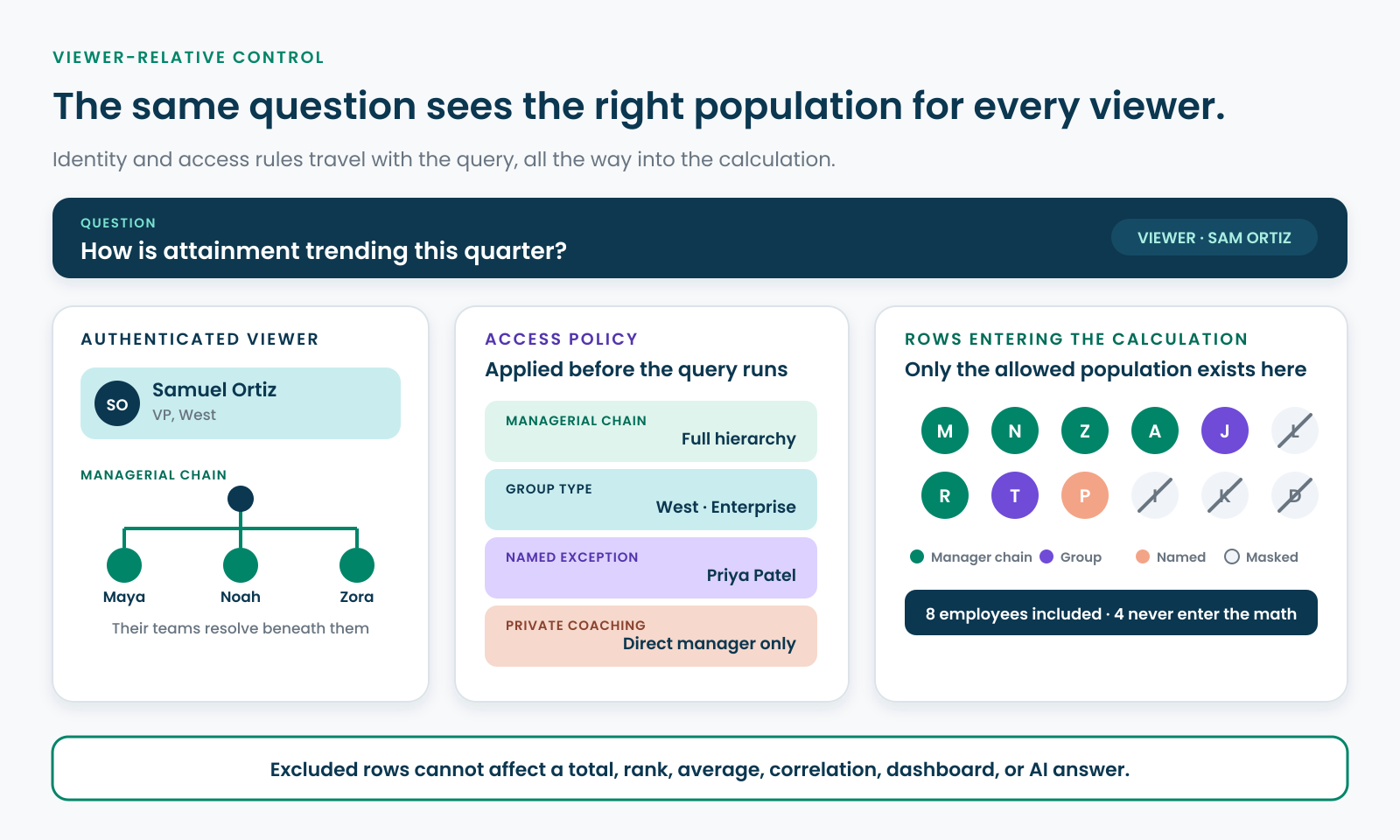
This allows one analysis to return an organization-wide answer for an executive and a direct-report answer for a frontline manager. The Agent, dashboards, workbooks, coaching, and MCP inherit the same policy. Governance does not depend on a prompt remembering what to hide.
Clarify the Language of the Business
A schema tells an AI where data is stored. It does not tell the AI what the business means.
The Performance Graph's semantic layer carries that meaning: the customer's definition of Pipeline Created, the order of opportunity stages, which transitions count as progress or regression, how fiscal periods work, and what “my team” resolves to for the current viewer.
The Agent works with employees, metrics, goals, coaching, opportunities, movement events, periods, and groups rather than reverse-engineering unfamiliar tables. Metrics know how they aggregate. Pipelines know their movement rules. Teams resolve through the organization and its access policy. A request such as “show what slipped since the start of the fiscal period, group it by region and leader, and rank the changes by value” becomes reliable enough to run the business.
If a model must reconstruct those facts from raw schemas at prompt time, the product is AI-assisted. It is not AI-native.
Make the Answer Operational
Most AI products stop when the answer appears. Revenue work starts there.
The same query system powers Ambition's workbooks, dashboards, TVs, homepages, pipeline views, and coaching. The Agent can turn an analysis into a live object that stays current and remains understandable to AI. A company can build one operating view and share it across the leadership organization; every executive, regional leader, and frontline manager receives the right population and only the data that person can access.
This reduces time spent assembling pre-reads and makes material changes less likely to be missed. The same operating methodology can be applied consistently across regions and teams.
People remain in control of what becomes real. The Agent can draft a coaching session, competition, skill, workbook, dashboard, or TV. The user can inspect the work, edit it, and revert changes before saving. AI removes preparation work; it does not replace judgment.
Skills and procedures make the organization's operating rhythm repeatable. A company can require opportunity analysis to follow MEDDPICC, tailor coaching guidance by manager group, and deliver a Monday pipeline brief to every leader. Skills run recurring work such as briefs and coaching pre-reads. Procedures supply the business rules the Agent should follow when a relevant situation arises. The Performance Graph keeps the facts underneath both current.
Meet People Where They Work
The same model can operate as a headless performance data layer. Through Ambition's MCP, customers can bring governed revenue context into an MCP-capable assistant such as Claude, ChatGPT, or Copilot instead of connecting that assistant independently to the CRM, engagement platform, conversation platform, HR system, and warehouse.
Customers choose the model. Ambition supplies the connected data, semantics, history, and permissions. An MCP query runs through the customer's model rather than invoking a second Ambition model, so customers do not pay for the same answer twice. The interface can change without fragmenting the truth underneath it.
The Product Is the Loop
Revenue performance does not improve because a system detected a signal. It improves when the signal reaches the right person, produces a better decision, and changes what happens next.
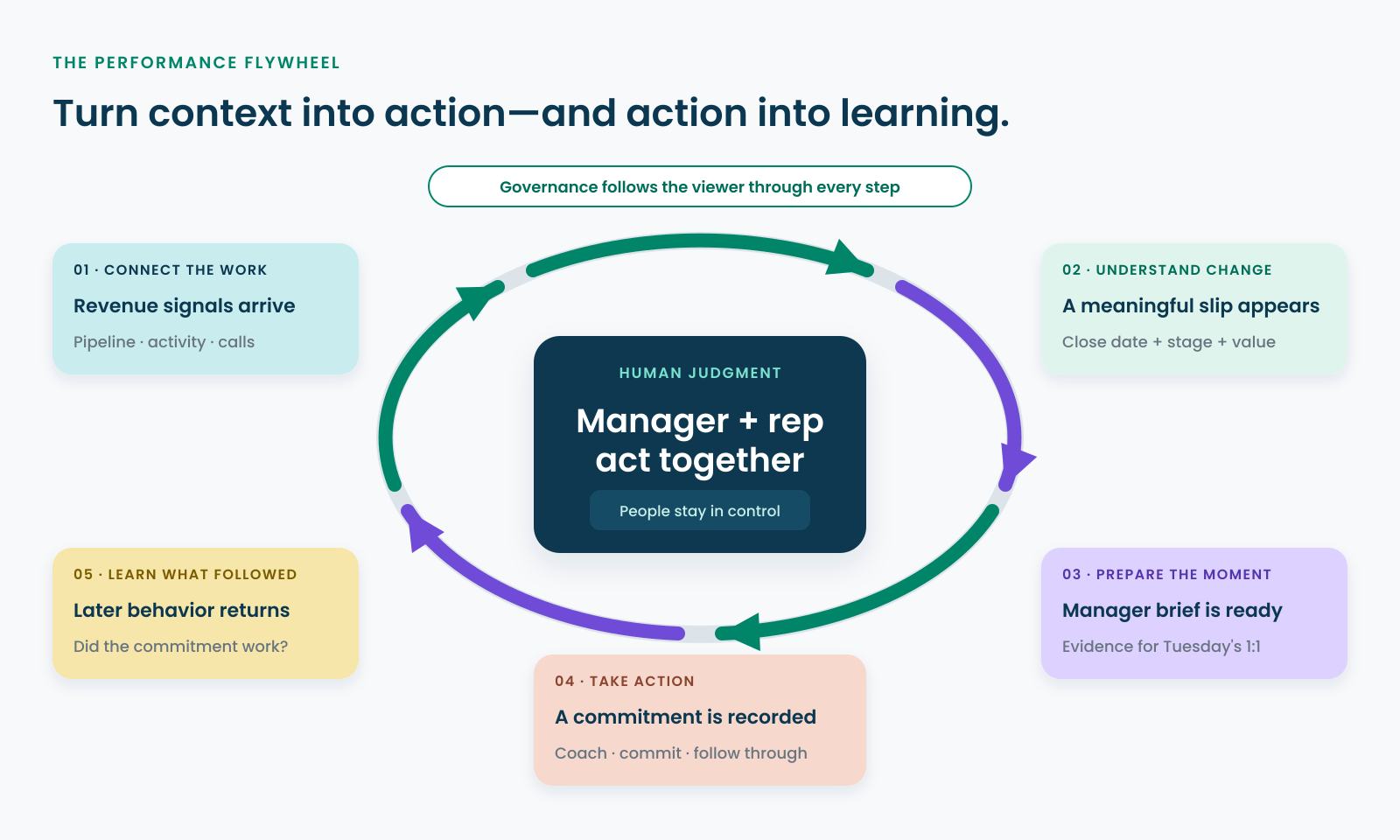
The Performance Graph connects that full cycle. Activity and pipeline data show what happened. Goals and scorecards define what was expected. Ambition identifies the moment worth attention. Coaching turns evidence into a conversation and a commitment. Later performance shows whether the commitment worked. Every cycle adds evidence about which coaching worked, which commitments held, and which signals mattered.
Connect the work → understand the change → prepare the right person → take action → learn from what follows.
Ambition does not automate people out of this loop. It gives revenue leaders, frontline managers, and reps the preparation and organizational memory that are nearly impossible to maintain manually across every employee, opportunity, metric, call, and commitment. Leadership can see whether the sales methodology is being applied consistently, whether coaching is changing behavior, and which parts of the operating system need attention.
The AI-Native Revenue Platform Is Built Before the Prompt
The next generation of revenue software will not be defined by how many systems place a chatbot beside their existing data. It will be defined by how much of the business AI can understand without guessing, how safely it can reason, and whether its work can move into the decisions that run the organization.
Models will keep improving. Interfaces will change. Governed business context compounds.
The Performance Graph is the foundation beneath Ambition's next generation: one employee-centered model that connects what happened, what was expected, who can see it, and what should happen next. It makes data a practical extension of the people running the revenue organization while giving leadership a way to encode how the company sells, coaches, and operates.
That is the work required to make AI useful in revenue: continuously prepare the context, govern it before calculation, and carry it all the way into action.
Bring us the revenue question that still takes an analyst, three exports, and a meeting to answer. See what it looks like when the context is already prepared.
See the system in action
Insights for high-achieving sales teams
.png)
.png)
Outbound Is Harder Than Ever. Here’s What’s Working Now: A Conversation with Jorge Soto
.png)

Stop chasing targets, start predicting revenue
Transform your revenue org into a high-performing growth engine with structured insights, top-down visibility, and built-in consistency.
%20(1).png)
.svg)
.svg)