.svg)
.svg)
.svg)
The Fundamentals of Great Sales Organizations Haven't Changed: A Conversation with Mike Kunkle

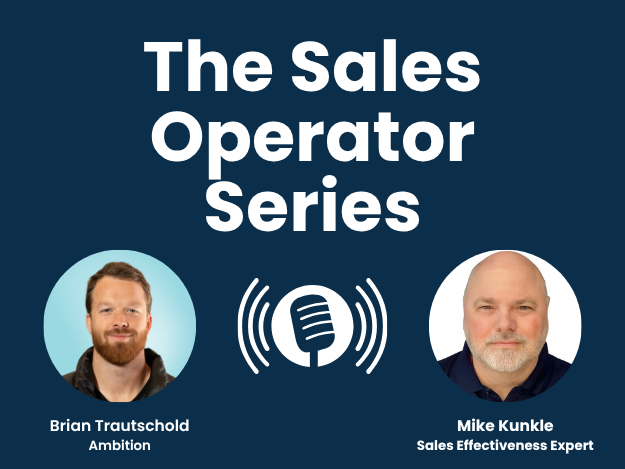
Every once in a while you have a conversation with a great sales leader that cuts through a lot of the noise. That was my experience during my most recent Sales Operator Series episode with Mike Kunkle.
Mike has spent more than four decades in sales and over 30 of those years helping organizations improve sales performance. With that kind of experience, I was curious whether he thinks today's sellers are fundamentally different than they were 20 or 30 years ago.
His answer was a little bit surprising. Obviously the technology has changed dramatically, as have markets and buyers. But the behaviors that consistently separate great sellers and great managers from everyone else haven’t changed nearly as much as you might think.
That idea was the jumping off point for our chat. If you want to see the whole conversation, check it out here.
The Best Sales People Focus on Understanding Before Solving
One of my favorite takeaways from our conversation was a framework Mike says he observes repeatedly while studying top performers, which he calls ACC: Acknowledge, clarity, confirm. Here’s how it goes.
First, the seller acknowledges what the customer is experiencing. Then, they ask thoughtful, clarifying questions to better understand the situation. Finally, they summarize what they’ve learned to confirm they understand it correctly.
It’s extremely simple, but highly effective. As Mike pointed out, one of the deepest human needs is to feel seen and understood. When a seller rushes to demonstrate expertise before they’ve demonstrated understanding, they usually fail to build trust with the customer. The best salespeople do the opposite, listening and thoroughly examining the customer’s situation before trying to provide value.
Better Systems Create Better sales Teams
Another theme that came up with Mike was the way many organizations think about sales and performance management. Most sales leaders will agree that the frontline manager role is critical. But if you go one click deeper and ask them how those managers actually develop their people, the answers will likely become much more vague.
Mike made the case that coaching shouldn’t be an occasional event; it should be a system (which is a hill we will always die on at Ambition).
A good coaching system allows a manager to easily diagnose where someone needs help, build a tailored development plan, practice skills with intention, review progress, and then repeat the process until improvement happens. Then, move on to the next opportunity for development and do it again.
If your managers are spending all their time in dashboards instead of focusing on performance improvement, you don’t have a coaching system.
Building on that, something I really appreciated about Mike’s perspective is that he rarely talks about individual tactics in isolation. Everything should fit into a broader system. That includes hiring, coaching, team meetings, performance reviews, and even technology. Each piece connects to and supports the others.
When you have a system of tactics that work together, continuous improvement becomes a built-in part of the culture rather than another one-off initiative. It’s a helpful reminder that sustainable performance improvement rarely comes from one great coaching session or a new tool, but from strong foundations and consistent execution over time.
Great Managers are Still the Biggest Lever
We ended the conversation talking about where organizations should invest if they truly want to improve performance. The answer that’s obvious to me is the frontline sales manager.
They’re the force multiplier, the people who identify problems early, develop talent, reinforce good habits, and are in the weeds helping sellers improve week over week.
When they’re successful and well-supported, the entire team gets better. When they aren’t, even the best strategies and tools struggle to create lasting results.
After talking with Mike, I came away thinking that it can be really easy to just get distracted by whatever’s new. But those organizations that are outperforming everyone else are winning because they’ve built systems that make improvement a continuous cycle, not because they’ve discovered some new sales secret.
If you enjoyed this recap, you can find my full conversation with Mike (and more episodes of the Sales Operator Series) here on Youtube.
See the system in action
Insights for high-achieving sales teams

.png)
.png)
Outbound Is Harder Than Ever. Here’s What’s Working Now: A Conversation with Jorge Soto

Stop chasing targets, start predicting revenue
Transform your revenue org into a high-performing growth engine with structured insights, top-down visibility, and built-in consistency.
%20(1).png)
.svg)
.svg)