


Build vs. Buy: An Honest Look at What it Takes to “Build Your Own” Ambition
Not too long ago we ran a demo for a prospective customer at an enterprise company who was really excited about our platform. During our call they expressed how they thought Ambition could really accelerate what their revenue teams are doing, and we left feeling like we were going to have a very happy new customer.
Turns out, they were so excited by what we showed them that they decided to build their own version of Ambition for their teams. A few weeks later, they came back and showed us a hodgepodge app they’d put together to do (some of) what Ambition does for their org. Flattering, but not exactly the outcome we had hoped for. Not to mention, what they made would probably work well for a time but require more ongoing maintenance than they’re willing to expend.
This is a very literal (and true) example of the larger build vs. buy conversation happening at companies. In most cases, the “build” option actually looks more like cobbling together the platform under consideration (for our purposes, Ambition) from the solutions in your existing stack.
Can you do this? Sure. Is it going to work out and be worth it? Eh.
But let’s get into it. We’re going to walk through the realities of building vs. buying Ambition, with candid pros and cons for each path.
Building vs. buying rule of thumb
In general, companies (should) follow a pretty simple framework for when to build a solution and when to buy one: Building works for simple, low-risk internal tools, while buying advanced platforms from experienced vendors is typically a safer path. To break that down:
- Internal development: Build simple, low-risk solutions with high outcomes rather than complex software systems.
- Vendor expertise: Rely on established platform teams that possess institutional knowledge and dedicated development resources.
It’s also important to consider data sensitivity. In this case, coaching notes and conversations can contain personal information that requires sophisticated permissions and maintenance. Third-party expertise allows for objective solutions and permissions to be implemented that respect the sales org hierarchy.
What build vs. buy actually means (usually)
Like we mentioned at the top, for most of Ambition’s audience, building doesn’t actually mean building. At least, not in the sense that we usually think of building software. What it really means is, “Can we recreate the outcome we would get from Ambition with a combination of the tools we already have?”
For example, the thinking might go like this:
- We have Salesforce, so we can just have RevOps build dashboards to track coaching activity
- We have Gong, so we can just use their coaching features
- We have a 1:1 template in a Google Doc and our methodology playbook is in a folder, so we just need to get managers to use them
Sure, these options feel cheaper and lower-friction in the short-term. But in most cases, they will fail in similar ways.
When building falls apart
Piecing together an Ambition-like solution from existing platforms seems like a good way to not rock the boat, but friction usually emerges at some point.
Specifically addressing the objections in the previous section:
- Salesforce gives you activity data but not coaching behavior data (like whether a 1:1 happened, what was covered, etc). RevOps can build a pretty dashboard of activity metrics, but execs will still have no signal on what’s actually happening with coaching.
- Gong excels at capturing what happens on a call, but it organizes everything around the deal and the recording. A manager using Gong for coaching is only doing it reactively, reviewing calls and coaching specific calls only after the fact.
- “We have a framework” is the most common situation, but without a system, adoption of the framework varies and depends entirely on the individual manager. (In fact, according to our Sales Coaching Benchmark Survey, 77% of orgs have some coaching framework but only 38% execute on it consistently.
Why building falls apart
Building your own internal tool feels good up front, but it’s not always a great long-term solution. When buyers choose to build, they often underestimate what it will actually take to create, maintain, and drive adoption. Here are some examples of that in practice.
1. The manager adoption problem is harder to crack than it seems
Even if RevOps builds something perfectly tailored, managers won’t change their behavior because of better reports or dashboards. Getting managers to actually incorporate something new into their ingrained processes requires a workflow that prompts them with the right information at the right moment. “Here’s what you need to know before your 1:1 with Jordan this afternoon, auto-generated from her pipeline, activity, and quota performance” is a very different experience than “log into Salesforce, check the activity dashboard, and draw your own conclusions.”
2. The data integration problem compounds over time
Getting Salesforce and Gong call data and quota performance and rep activity scores into a single coherent view that a manager can interrogate and act on requires ongoing integration work. Every time a team grows, or the CRM data model changes, or a new tool is introduced, work is created for someone. RevOps time spent on coaching infrastructure is time not spent on critical strategic work like pipeline forecasting, compensation modeling, or territory design.
Auto-generated coaching agendas, MEDDIC adherence detection, rep-level skill gap recommendations, and coaching effectiveness scoring are all needs that are not achievable by stitching together existing tools. It requires a data layer that combines signals from multiple sources and applies models built specifically for this use case.
4. The coverage problem is invisible until you measure it
According to Ambition’s recent State of Sales Coaching survey, 64% or organizations coach fewer than half of their reps weekly. When you’re building reporting from existing tools, coaching coverage is essentially untrackable. Maybe you know that a 1:1 is scheduled, but you don’t know whether it happened, what was covered, or whether every rep on the team is being reached consistently.
Where the real tradeoffs are for building vs. buying
All said, there remain some real reasons to hesitate on buying.
- Stack fatigue: Revenue teams are already paying for Salesforce, Gong, Seismic, and a methodology partner fear redundancy and are understandably wary about adding another platform. We don’t pretend that Ambition is a replacement for any of these solutions. But investing in the manager coaching and context layer is a major enhancement to what you’re already doing. It’s the connective tissue that makes the rest of your sales stack worth what you’ve paid for it.
- Budget: Obviously. Revenue leaders can pretty easily sign off on Gong, Seismic, and Salesforce as must-haves. We know that proving the ROI of a coaching and performance system is trickier, but the ROI is very real. Our recent survey found that organizations with higher coaching coverage are twice as likely to see 75%+ quota attainment. You can also calculate your specific organization’s projected return with our ROI calculator here.
- Compliance and governance: Another non-negotiable. Any time you onboard new systems, these concerns come up. Luckily Ambition rises to the occasion on all fronts, with SOCII certification, BYOK, and permission-aware AI. Learn more in our Trust Center.
How to choose between building and buying
No surprise that there’s no clear, black-and-white answer on when to build versus when to buy. When it comes to sales coaching and performance, we’re firmly in the camp that you will not get the same quality, context, and consistency by piecing together tools that you will get with a dedicated system.
Ambition is purpose-built to operationalize and optimize coaching for large revenue organizations with automations proven to drive better performance and long-term growth.
If you’re evaluating building vs. buying for coaching and performance, we’d love to talk. Get in touch with our team here.
See the system in action
Insights for high-achieving sales teams
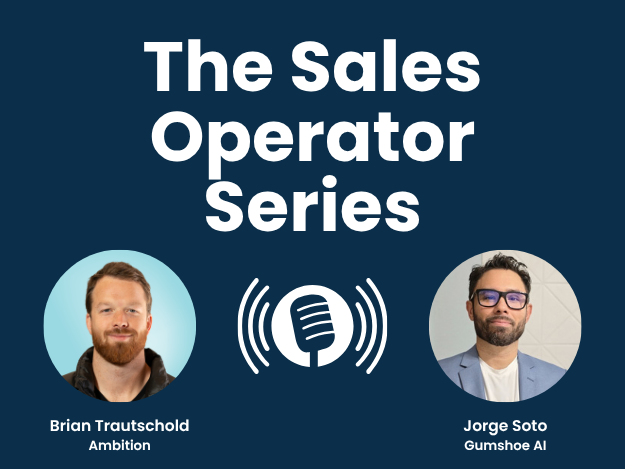
Outbound Is Harder Than Ever. Here’s What’s Working Now: A Conversation with Jorge Soto

Stop chasing targets, start predicting revenue
Transform your revenue org into a high-performing growth engine with structured insights, top-down visibility, and built-in consistency.


