


Outbound Is Harder Than Ever. Here’s What’s Working Now: A Conversation with Jorge Soto

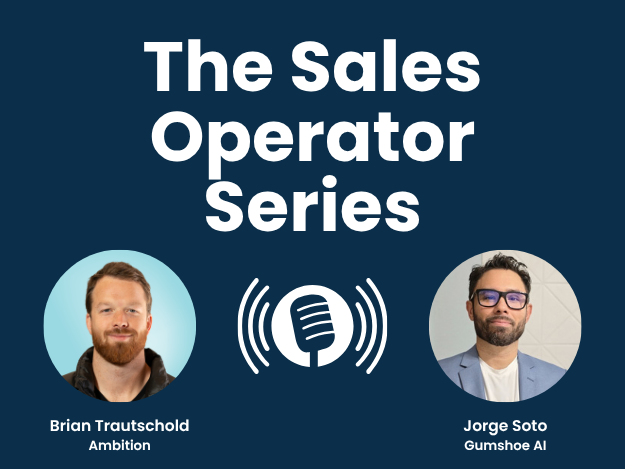
GTM veteran Jorge Soto on AI-personalized inbound follow-up, lead magnets with personality, outbound that proves you’re human and “account-based podcasting.”
Most sales leaders I talk to agree that outbound is harder than ever. The more useful question is what to do about it. So I asked Jorge Soto, a B2B sales and go-to-market veteran and host of The GTM Pack, what has changed most for him in the last twelve months, on the Sales Operator Series.
His answer started with AI but quickly became about something else: pairing AI with product-led growth and inbound so that when someone shows up, you give them a truly personalized experience. And when you do have to do outbound, you need to prove there’s a real human on the other end.
Here’s a recap of our conversation. You can also watch the full episode below.
Where should sales leaders focus when outbound is so hard?
Jorge said he didn’t want to sound cliché about AI, but he wanted to mesh it with PLG and inbound. His view is that effectively executing outbound is “its own world” at this point. It isn’t impossible, since some people are doing it well, but he thinks sales organizations should align closely with marketing on lead magnets and product-led experiences that bring people in. He was upfront that none of this is rocket science. The hard part is executing it.
He gave a recent example: a huge Fortune 100 brand signed up for his company’s product. His reaction was that the buyer had come to them, so they needed a system for landing and expanding. The first sign-up might be small, but you can use AI and traditional tactics to reach out and build something personalized, then combine that with traditional enterprise strategies. This maps closely to what we’re seeing at Ambition.
How can AI agents personalize inbound follow-up?
When most people hear “AI for sales,” they picture putting outbound on cruise control. Jorge is describing something different: creating a bespoke experience once someone is already aware of you or exploring your product.
Here’s the picture he painted. Someone signs up through your lead magnet, web form or product. An AI agent then:
- Works out who that person is.
- Tailors the messaging and sends the follow-up.
- Includes the booking link.
- Spins up a personalized one-pager.
I told Jorge it reminds me of how consumer marketing works. Shop for something on Instagram and suddenly it follows you everywhere online. B2B is going through its own version of that consumerization, and AI lets us do it in a tailored way. Jorge agreed that much of today’s marketing and brand building, even something like this podcast, looks more like consumer marketing than traditional B2B. His summary: “We need to be more human.”
What makes a strong lead magnet?
Jorge pointed to a few formats: traditional ones like ROI calculators, and product-led experiences that add value to a prospect’s day-to-day. His favorite approach is a specific playbook tied to your brand and your use cases. It starts with strategy in your own voice, then shows how to implement it with your tool, mapping specific product features to the playbook.
I pushed him on the “layup” objection, since some revenue leaders will say they don’t have a PLG motion. I suggested the intent line can be defined differently. A sign-up is a strong signal, but so is filling out an ROI form, using a tool or downloading content. The point is to create more opportunities for prospects to interact so you know when to reach out.
Jorge also emphasized having a service-minded, selfless approach to content. Start with the value to the prospect.
Gong’s personality play
Jorge’s favorite example of a brand with personality is Gong. The company ran a report on win rates for reps who swear on calls, and found a correlation between swearing and higher conversion. It was counterintuitive, completely on-brand and it earned attention. I liked the double benefit. It’s genuinely interesting, which is hard for a marketer to achieve, and it builds trust because you get a unique insight from the brand.
What does outbound that proves you’re human look like?
Jorge acknowledged we’re all still getting daily cold emails that are just wrong, including ones that mention competitors. The way through, he says, is to embed something AI and automation can’t replicate.
He shared a conversation with a CRO who planned to send 15 to 25 manual messages a day because of spam filters. Jorge’s advice: record a personalized video for each one. Look into the camera and say something like, “Hey Brian, this is Jorge over at X Company. By the way, I’m a real person here.” It doesn’t scale, and that’s the point. The CRO’s response was that he’s not good on camera, and he didn’t take the advice.
My reaction was that it’s dystopian on one hand that we have to prove we’re human, and on the other it could make sales more fun. Sales became cookie-cutter and optimized at scale. An exec or AE who spends 15 seconds recording a simple video and a minute writing a personal email will stand out from the mail-merge messages we all get. Add a good reason to reach out, like “we work with a lot of companies that look like you because of X,” and you’ve given them a reason to talk for 20 minutes.
Are events and field marketing coming back?
I have a pet theory that pendulums swing. We’re putting so much into inbound intent generation that outbound will come back around in a different form. I mentioned that Morgan Ingram told me he thinks everyone will become a field seller.
The challenge is efficiency. From 2015 through 2022, everything was about scale: more bodies, more campaigns, more sequences, with shrinking conversion rates. If you go to someone’s office, you can only visit a couple a day. Jorge’s answer was to build experiences, such as dinners, conferences and field events, that let you meet many people at once. He also thinks those experiences should go beyond the traditional B2B playbook and feel more like consumer marketing.
What is account-based podcasting?
Jorge’s example came from his time running a startup in San Francisco. His team built a booth at events where people could stop by and record a video. It started a relationship quickly and created content they could repurpose.
That’s why he tells founders to think of it as account-based podcasting: interview-style conversations with people at the accounts you want to reach, supported by a salesperson with an account-based approach. It was the first time I’d heard the term. For the record, I’m not doing that here. I just like talking to interesting people.
It connects to something I believe about the last few years. We made interactions so structured that the person on the other end got asked things like “Do you have the authority to buy software?” or “Who has budget?” before they even knew what the product was. A recorded conversation happens organically and builds a relationship instead of qualifying someone.
What should sales leaders start doing right now?
Jorge’s closing advice is to stick to the fundamentals and not use AI just to use it. Think through where the human interaction or workflow sits and make sure it’s more than checking a box. He wants a blend of new innovation and a human touch, not automating everything.
When I asked for one thing leaders should start doing yesterday, his answer was that sales leaders have to be marketing machines through content and podcasts. You have to stand out somehow, and he named Chris Orlob as a great example.
I asked whether we’d all be inundated with videos. Jorge said we’re already seeing that, and I agree. But I think the answer is to make yours worth watching.
What I’m taking away
The pattern across Jorge’s examples is that AI handles the research and the follow-up, while humans handle the moments that build trust. For leaders, that means looking at where your motion is checking a box, and deciding where a real person should show up.
To hear the whole conversation, watch the full episode on the Sales Operator Series. You can follow Jorge on LinkedIn.
See the system in action
Insights for high-achieving sales teams
Outbound Is Harder Than Ever. Here’s What’s Working Now: A Conversation with Jorge Soto


Stop chasing targets, start predicting revenue
Transform your revenue org into a high-performing growth engine with structured insights, top-down visibility, and built-in consistency.


